

Dear Creative,
In my years at Interscope and Disney, the goal was always volume. Get the streams, hit the charts, feed the machine. But even with 25 million global streams, the math rarely adds up for the independent creator.
This week, I sat down with Christian Holl Buhl, frontman of the indie rock powerhouse Dead Star Talk. They’re doing something radical: they released their last album, Solid State Chemicals, and pulled it from Spotify after just 30 days.

We talked about why the streaming model is "fundamentally broken," the magic of recording with Flemming Rasmussen (Metallica), and why the future of music is artist-centric—or it’s nothing at all.
Dear Creative: You pulled Solid State Chemicals from Spotify after just one month. What was the "breaking point" that led to this decision, and what has the fan reaction been like on the platforms where the music is still available?
Dead Star Talk: We pulled Solid State Chemicals from Spotify after just one month for several reasons. First of all, we’re a small indie rock band—our core fans tend to buy vinyl anyway, so we’re not commercially dependent on streaming in the same way many artists are. In that sense, we didn’t have much to lose.

Secondly, the Spotify revenue model is fundamentally broken. It isn’t fan-centric; subscription income is pooled and then redistributed statistically across the catalog, which heavily favors the major labels in each market. Policies like the 1,000-stream minimum—where tracks below that threshold receive no royalties—mean that roughly a third of the songs on Spotify are essentially there for free. That’s extremely unfriendly to diversity and independent music.
And thirdly, there are broader ethical concerns—for example Daniel Ek’s investments in military technology. Altogether, there were enough reasons for us to make a statement with this release.
Dear Creative: Many artists fear that being off streaming makes them invisible. How are you maintaining your "Global Hit" momentum while bypassing the traditional algorithms?
Dead Star Talk: To be honest, you can’t completely replace the visibility that streaming algorithms provide. What we’re doing is a bit punk rock.
We’re not chasing a global hit—we’re chasing the best possible songs and a connection with the right audience. We focus on live shows, physical releases, and direct engagement with fans. We’ve had songs placed on editorial playlists at Spotify, Apple Music, and Deezer before, and it definitely makes a difference.
But for a small independent band, streaming rarely translates into meaningful revenue anyway. So rather than chasing algorithms, we prefer to build our audience in other ways.
Dear Creative: How do you see tools like limited vinyl or digital collectibles (NFTs) changing the way a band like Dead Star Talk builds a sustainable career without a major label middleman?
Dead Star Talk: That’s exactly the point,
"We don’t believe we need a middleman."
We operate with a strong independent ethos, and vinyl has been central to that from the beginning. At the same time, new tools like NFTs or other digital collectibles are genuinely interesting because they allow artists to connect directly with their audience.

We’ve already seen good engagement on platforms like ORB, and we think these kinds of direct-to-fan systems could become an important part of how independent artists sustain themselves.
DC: Working with Flemming Rasmussen brings a legendary, high-fidelity "wall of sound". In an era of bedroom pop and compressed audio, why was it important for you to go the "Sweet Silence" route?
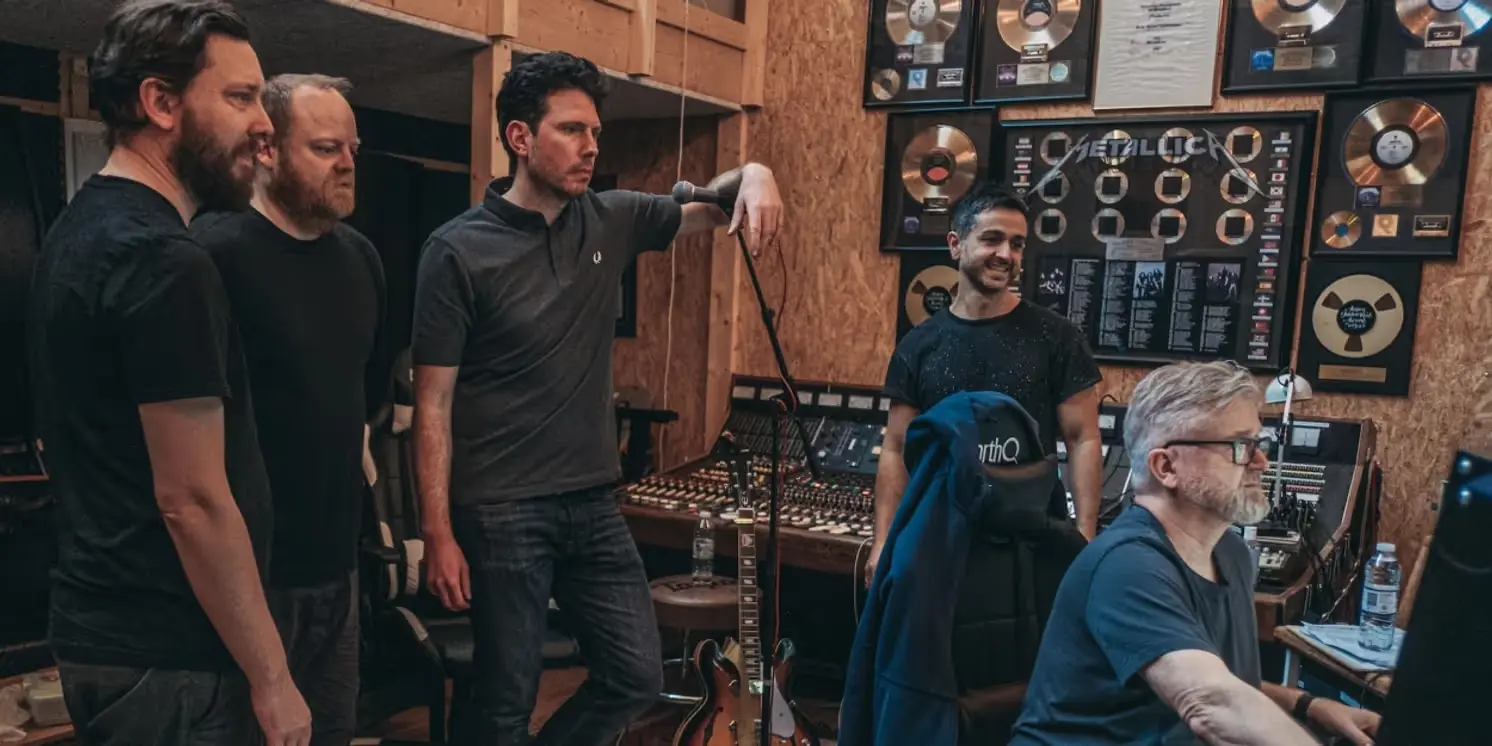
DST: First of all, it’s been a huge honor that Flemming Rasmussen wanted to work with us. We’ve never recorded with anyone else—he’s been instrumental in shaping our sound and has really taken us under his wing.
We recorded our first album, Too Many Too Much, during the pandemic, isolating ourselves in the studio with him for a couple of weeks. It was an intense but special experience.
The reason we work this way is simple:
"We believe in being a real band. We play instruments—guitars, Turkish saz, drums, percussion—and we record them properly. Vocals are done in a few honest takes, not endlessly edited."
In an era where many productions rely on the same loop packs and presets, recording in a studio like Sweet Silence allows every sound to be unique. You might layer guitars with different instruments, microphones, and amps until the sound becomes something completely distinctive.
That’s how classic records were made—from the Beatles and Led Zeppelin to Oasis and Bob Dylan—and that uniqueness is something we really value.
DC: The interplay between Christian and Günes is a hallmark of your sound. How do you decide who takes the lead on a track, and how does that dynamic influence your songwriting?

DST: The interplay between me and Günes is central to the band, both vocally and instrumentally.
I write the songs—usually on an acoustic guitar, often a Gibson SJ-200—and that’s where the structure and foundation come from. Günes then develops much of the intricate guitar work and sonic layering, while I focus on rhythm.
Vocally, the contrast between our voices creates the dynamic. My voice is deeper and more husky, while his is higher and more piercing. When you combine them—especially in harmonies—it creates a unique texture.
Epiphone J-200 Studio EC Jumbo Acoustic Electric, Vintage Sunburst with Bag
The Epiphone J-200 Studio EC acoustic guitar is a distinguished model, celebrated for its Super Jumbo body and remarkable sound projection. Inspired by the legendary Gibson SJ-200, "The King of the Flat-Tops," this guitar boasts a cutaway for improved access to the upper frets. The J-200 Studio E...

There aren’t strict rules about who sings what. But generally, my voice forms the baseline of the sound because I write the songs, while his voice adds the dynamics—almost like a distortion pedal for vocals.
DC: As we see more AI-generated content, there’s a push for standards like C2PA to verify human-made work. As a band that values "real" rock, what’s your take on the role of AI in music?
DST: Honestly, I’m fairly relaxed about AI in music. On an industrial level, there are certainly concerns—especially if streaming platforms start filling playlists with AI-generated content.

But for independent artists creating real music, I’m not overly worried. Songwriting itself is already mysterious.
As Noel Gallagher once said, writing a song is like fishing—you don’t decide to do it, it just arrives. Sometimes in two minutes: melody, lyrics, structure, everything. And you have no idea where it came from.
That’s the magic of it. AI can do its thing—I think society will face far bigger questions about AI than the music industry.
DC: If you could rebuild the music industry from scratch today—knowing what you know about Web3 and artist ownership—what is the first thing you would change for the next generation of creatives?
DST: If I could rebuild the industry from scratch, the first thing I’d change would be the redistribution model.
"Subscription systems should be artist-centric."
If someone pays €10 a month for a streaming service, that money should go directly to the artists they actually listen to—and no one else.
Christian didn't hold back on the current streaming math. He pointed out that Spotify's new policies essentially make a third of the platform's music "free labor" for the major labels.
"Subscription income is pooled and redistributed... which heavily favors the major labels. Tracks below the 1,000-stream threshold receive no royalties. That’s extremely unfriendly to diversity."
While they acknowledge that skipping the algorithm is a risk, they’re doubling down on direct-to-fan engagement through platforms like ORB (on Lens) and limited vinyl. They aren't chasing a "global hit"; they're chasing a real connection.
Despite the rise of AI, Christian remains "relaxed." He views songwriting as "mysterious fishing"—a melody that arrives in two minutes from somewhere unknown. For them, the "wall of sound" created at Sweet Silence Studios is something a loop pack can't replicate.
Omi AI - note taking app recorder for voice to notes transcription
Meet Omi AI, your note taker app recorder to remember everything in work and personal life! Voice to notes transcription with automatic tasks and memories, search and AI chat.

What Christian describes—a world where your €10 subscription goes directly to the artists you actually listen to—is exactly why I’m building the Creative Platform.
Whether it's Creative TV offering 100% revenue retention or Creative Finance managing on-chain liquidity for vinyl runs, the goal is the same: rebuilding the industry from scratch. ---

Listen: Find them on Apple Music, Deezer, or grab their vinyl.
Solid State Chemicals by DEAD STAR TALK on Apple Music
Listen to Solid State Chemicals by DEAD STAR TALK on Apple Music. 2024. 10 Songs. Duration: 36 minutes.
