Gawain "G2" Bracy II is a music producer, software developer, and the founder of Creative Platform, where he has spent the last five years building tools that let creators own their work and their audience. A Disney and Interscope producer turned builder, he writes Dear Creative for independent creatives navigating art, tech, and the business of making things. He is also the author of The Future Thread (books.creativeplatform.xyz).
Listen to Dispatch
Browser speech • ~6 min listen
0:00 / 6:00
★Executive Takeaway
Cultivating Culture as Industrial Policy
Core thesis for Part 2: The Rise of the "Orange Economy"
⚡One-Click Micro-Support • Base USDC
Send 0.25 USDC to back "Part 2: The Rise of the "Orange Economy"".
Direct, instant micro-value flow on Base with sub-cent gas fees. Zero paywalls, 100% creator-direct.
Recipient: 0xfc15...02aF
How was this dispatch?
Your reaction feeds directly into Adam's editorial model to prioritize future deep-dive topics.
Dear Creative,
In Part 1, we examined the legal battles defining the data wars. Today, we look at the economic reality driving those fights. The visual identity of this series—vast agricultural fields overlaid with digital circuit nodes—is no accident. It is the perfect metaphor for 2026: Culture is no longer "wild growth." It is being cultivated, partitioned, and regulated as essential industrial infrastructure.
The most aggressive move in this "cultivation" strategy arrived this February in India’s Union Budget 2026-27. Finance Minister Nirmala Sitharaman has officially positioned the creative industries as a primary engine of services-led growth.
The government is putting hard numbers behind this shift:
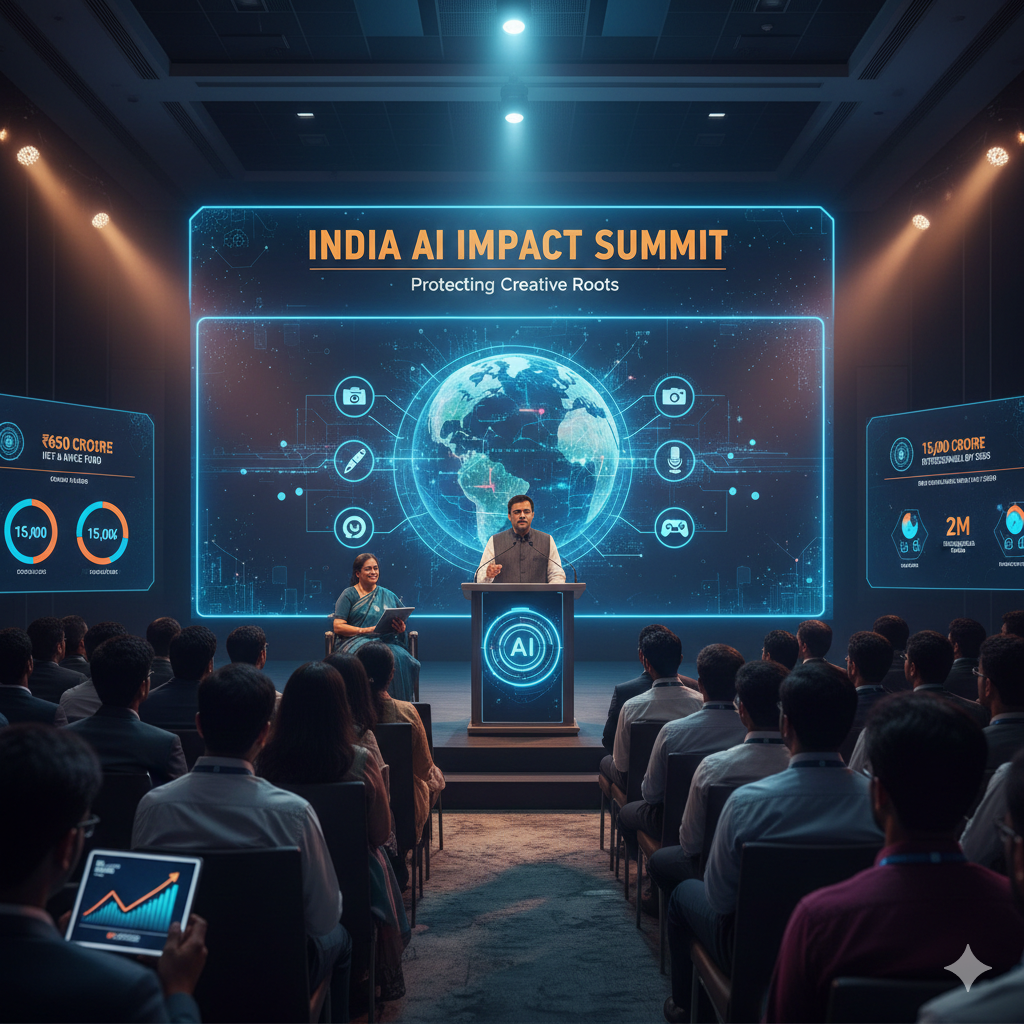
• The Investment: A combined allocation of ₹650 crore (approx. $78M USD) specifically for the Indian Institute of Creative Technologies (IICT) and talent development in the AVGC (Animation, Visual Effects, Gaming, and Comics) sector.
• The Cultivation: This funding establishes "Content Creator Labs" in 15,000 secondary schools and 500 colleges. The goal is to train 2 million professionals by 203012.
Breaking News (Feb 23):
India's AI Impact Summit
This domestic policy is now becoming foreign policy. At the inaugural India AI Impact Summit just last week, Union Minister Ashwini Vaishnaw called for an "international consensus" to protect the roots of creative energy amidst the AI boom. He described the relationship between AI and copyright as "very, very complex," signaling that India intends to lead the global regulatory conversation, not just follow it.
2. The "Concert Multiplier" & The Destination Economy
Why are governments treating creativity as heavy industry? Because the Economic Survey 2025-26 proves that "ephemeral" events create permanent economic spikes.
Evolving concerts into cultural destinations.
The survey identifies the "Concert Economy" (valued at ₹100 billion in India alone) as a massive tourism multiplier 3. A single mega-event generates value far beyond the box office, boosting hospitality, logistics, and security sectors.
The "Experiential" Shift (Feb 13): This trend extends beyond pop concerts. On February 13, it was announced that David Hockney will create a ten-meter-long window installation for the Turner Contemporary museum. This is a prime example of the "experiential cultural destinations" highlighted in the 2026 economic playbook—investments designed to turn artistic landmarks into engines for local tourism revenue.
3. The Global Friction: "Hostility" vs. "Superpower" Strategies
While India and the UK (with its new "Sector Plan" targeting £31 billion by 2035) are aggressively funding "Createch", other regions are hitting a wall.
Save up to 60% off on Acer products.
New Reports (Feb 15): Fresh data out of the European Union indicates a growing "hostility toward risk-taking innovators." Critics argue that aggressive regulation is causing stagnant growth, preventing the EU from fostering competitive rivals to U.S. AI giants like Anthropic. This creates a stark divergence in 2026: while some nations cultivate creativity through incentives, others may be stifling it through restriction.
Superpower strategies vs. Global friction
4. The Human Element: The "Soul" Amidst the Silicon
As governments industrialize creativity, artists are drawing a hard line between "content" and "art."
• The "Soul" Argument (Feb 14): Actor Abhishek Bachchan made headlines this Saturday by cautioning that while AI benefits budgets and animation, it lacks the "soul" and human imperfection that defines cinema.
• Professionalism & Protest (Feb 14-16): At the Make-Up Artists and Hair Stylists Guild Awards,
the winners included One Battle After Another and Sinners. But the night was defined by hair stylist Ahou Mofid, who dedicated her award to the "Free Iran" protests outside.
The Takeaway: The "Orange Economy" of 2026 is a paradox. On one side, it is a sterile industrial policy of "content labs" and "GDP multipliers." On the other, it remains deeply human, political, and resistant to automation. As we move toward the Agentic Web in Part 3, this tension between generated content and lived creation will define the market.
Coming Up in Part 3: The Agentic Web & The Liability Crisis—How AI agents are becoming the new gatekeepers of culture, and why Meta is facing a jury for "addictive design."